The Energy Corridors
The narrow sea lanes, pipelines, and terminals that quietly move the world’s energy.

Ledger Report
Energy rarely moves in straight lines.
It follows routes.
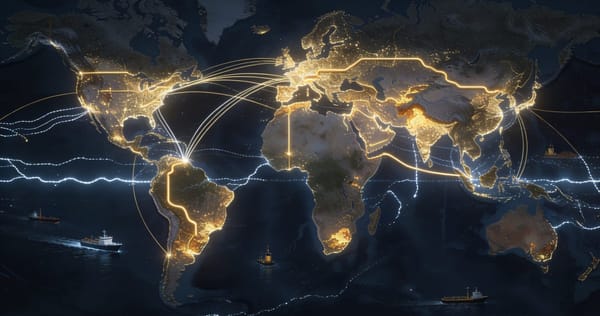
Across oceans, through narrow straits, across deserts, and beneath continents. Tankers carry oil between producing regions and the countries that depend on it. Pipelines stretch thousands of miles across land. Liquefied natural gas travels by ship between export terminals and distant ports.
But like trade, energy does not move evenly across the map.
It moves through corridors.
And many of those corridors are incredibly narrow.
The Narrow Passages That Power the World
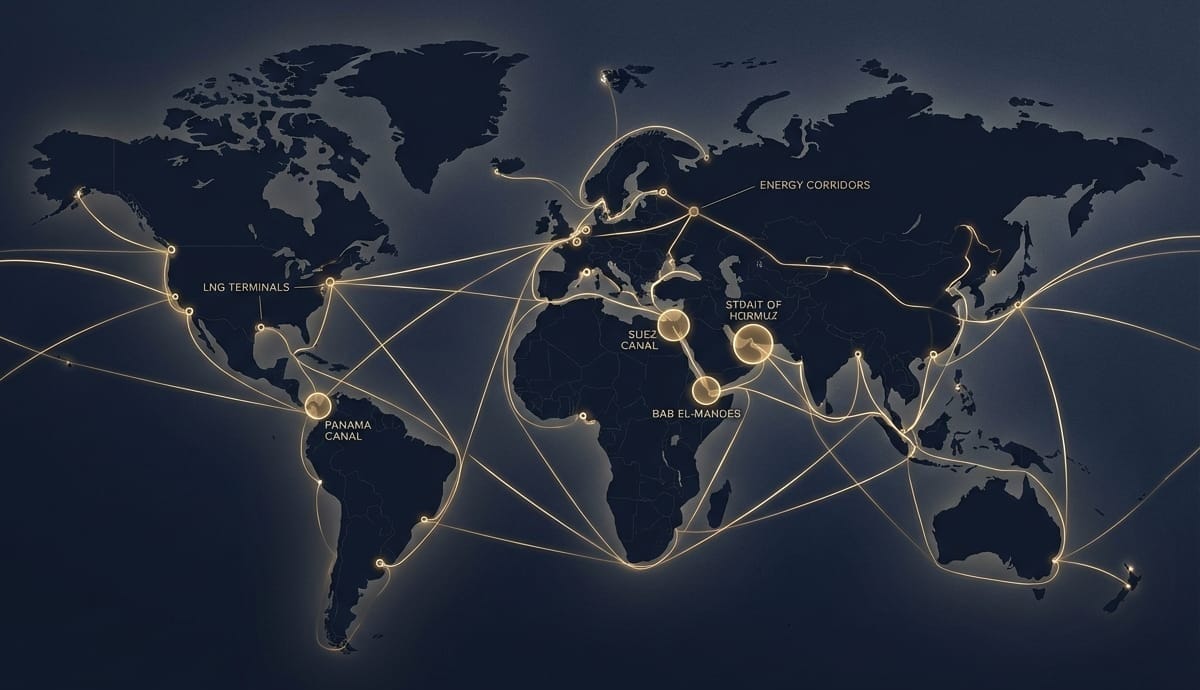
Take the Strait of Hormuz.
This thin channel between Iran and Oman carries a significant portion of the world’s oil exports every day. Tankers leaving the Persian Gulf must pass through it on their way to Asia, Europe, and beyond.
Or the Suez Canal.
By connecting the Mediterranean to the Red Sea, it allows energy shipments to move between the Middle East and Europe without sailing around the entire African continent.
Further south sits the Bab el-Mandeb Strait, another narrow passage linking the Red Sea to the wider Indian Ocean.
Disruptions in any of these places ripple quickly through global energy markets.
Pipelines Beneath the Surface
Not all energy moves by sea.
Across continents, pipelines quietly move enormous volumes of oil and natural gas.
Russian pipelines run west toward Europe. Central Asian pipelines connect inland fields to distant markets. North America has its own dense network of lines moving energy from producing basins to refineries and export terminals.
Most of this infrastructure remains invisible to the public.
But it forms the backbone of the global energy system.
A System Built on Corridors
From sea lanes to pipelines to LNG shipping routes, the global energy system depends on a surprisingly small number of corridors.
These routes shape prices, influence geopolitics, and determine how quickly energy can move when supply shifts.
Understanding where those corridors are — and how they connect — reveals a great deal about how the modern world actually runs.