The Hidden Grid Beneath the Ocean
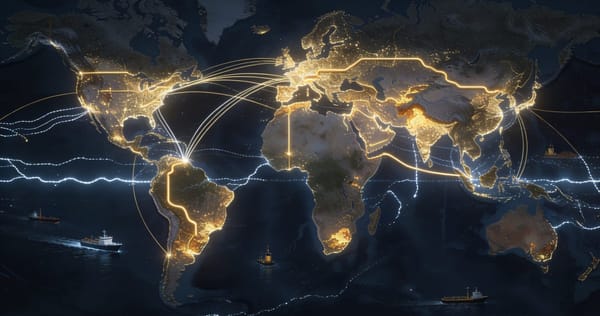
Nearly all global internet traffic travels through fragile fiber-optic cables lying on the ocean floor. The infrastructure few people see is quietly shaping the next decade of the digital economy.

How Submarine Cables Quietly Carry the Global Economy
Nearly everything we do online moves through glass threads lying on the ocean floor.
———
Most people assume the internet lives somewhere in the cloud.
In reality, nearly all of it travels through glass.
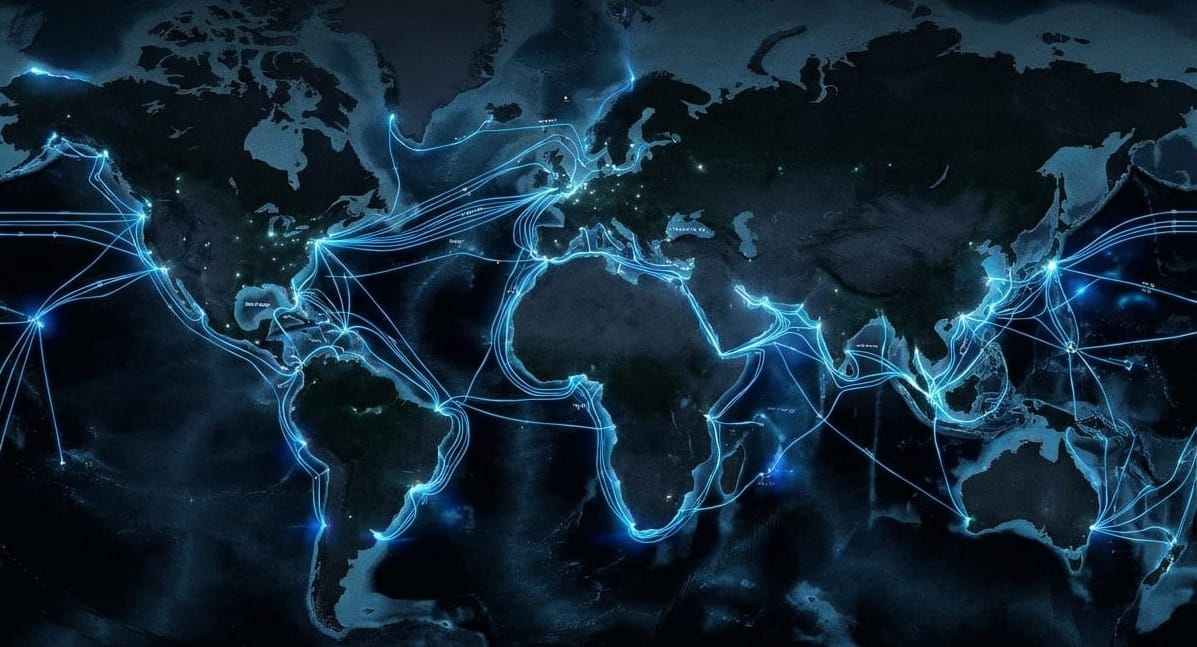
More than 95% of global internet traffic moves through submarine fiber-optic cables, stretching across continents and oceans like an unseen circulatory system for the digital world. Satellites carry only a small fraction of global communications. The infrastructure that powers the internet is overwhelmingly physical — long lines of fiber laid carefully along the seabed.
These cables are the reason markets settle trades in milliseconds, financial data moves instantly across time zones, and cloud platforms operate seamlessly across continents.
They are also one of the least visible pieces of critical infrastructure on earth.
Across the Atlantic.
Across the Pacific.
Through narrow corridors in the Mediterranean, the Red Sea, and the South China Sea.
What appears to be a borderless digital network is, in fact, a carefully constructed physical system.
And it sits in places most people never think about.
A Quiet Race to Build the Next Network
For decades, submarine cables were built mostly by telecom consortia.
That model has changed.
Today, the largest builders of global cable infrastructure are technology companies.
Amazon, Google, Microsoft, and Meta have all become major investors in submarine cable networks, financing massive routes connecting global data centers and cloud regions.
The logic is straightforward: whoever controls the fastest routes controls the backbone of the digital economy.
These cables determine:
• how quickly cloud services move data
• how financial markets communicate globally
• where new data centers are built
• which regions become digital infrastructure hubs
In many ways, submarine cables now shape the geography of the modern economy.
Pull Quote
“The cloud isn’t floating above us. It’s resting quietly on the ocean floor.”
A System Built on Fragile Lines
Despite their enormous importance, submarine cables remain surprisingly delicate.
Most are only about the width of a garden hose.
They stretch across the seabed for thousands of miles, occasionally buried near shore but often lying exposed in deep water.
Damage happens more often than many people realize.
Most cable breaks come from ordinary causes — fishing trawlers, ship anchors, and geological activity.
But the strategic implications have grown in recent years.
Governments increasingly classify submarine cables as critical national infrastructure, placing them in the same category as power grids and transportation systems.
The concern is simple: if enough cables were disrupted simultaneously, entire regions could lose connectivity and global financial systems could slow dramatically.
The New Strategic Chokepoints
Some parts of the world carry an outsized share of the internet’s traffic.
The Red Sea corridor, the Strait of Malacca, and several Mediterranean routes host dense clusters of cables connecting continents.
These areas function as digital chokepoints — narrow geographic corridors through which enormous amounts of global data must pass.
To reduce reliance on these routes, new projects are exploring alternative pathways.
One emerging idea is Arctic cable routes, which could shorten connections between North America, Europe, and Asia.
Meanwhile, major technology firms are quietly constructing entirely new cable corridors to support the growing demands of artificial intelligence and global cloud computing.
What once resembled telecommunications plumbing is increasingly beginning to look like a global logistics network.
Pull Quote
“Modern markets move at the speed of fiber.”
The Infrastructure Few People See
Submarine cables rarely make headlines.
They operate quietly in the background, rarely noticed unless something goes wrong.
Yet they form one of the foundational systems of the modern economy — connecting financial markets, powering cloud infrastructure, and linking continents through nearly invisible lines of glass.
Every international message, trade execution, and cloud transaction likely travels through one of these cables.
Not through the cloud.
Through the ocean.
Why It Matters
The modern economy runs on speed.
Submarine cables determine how quickly information moves between continents, how resilient global networks remain during disruption, and where the next generation of digital infrastructure will be built.
As artificial intelligence, cloud computing, and real-time financial systems expand, the demand for faster and more resilient cable routes is accelerating.
Most of this infrastructure will remain invisible.
But its influence will not.
The Ledger View
The systems shaping the modern world are rarely the ones people see.
They sit quietly beneath the surface — beneath markets, beneath politics, and sometimes beneath entire oceans.
Submarine cables are one of those systems.
Invisible most days.
Essential every day.